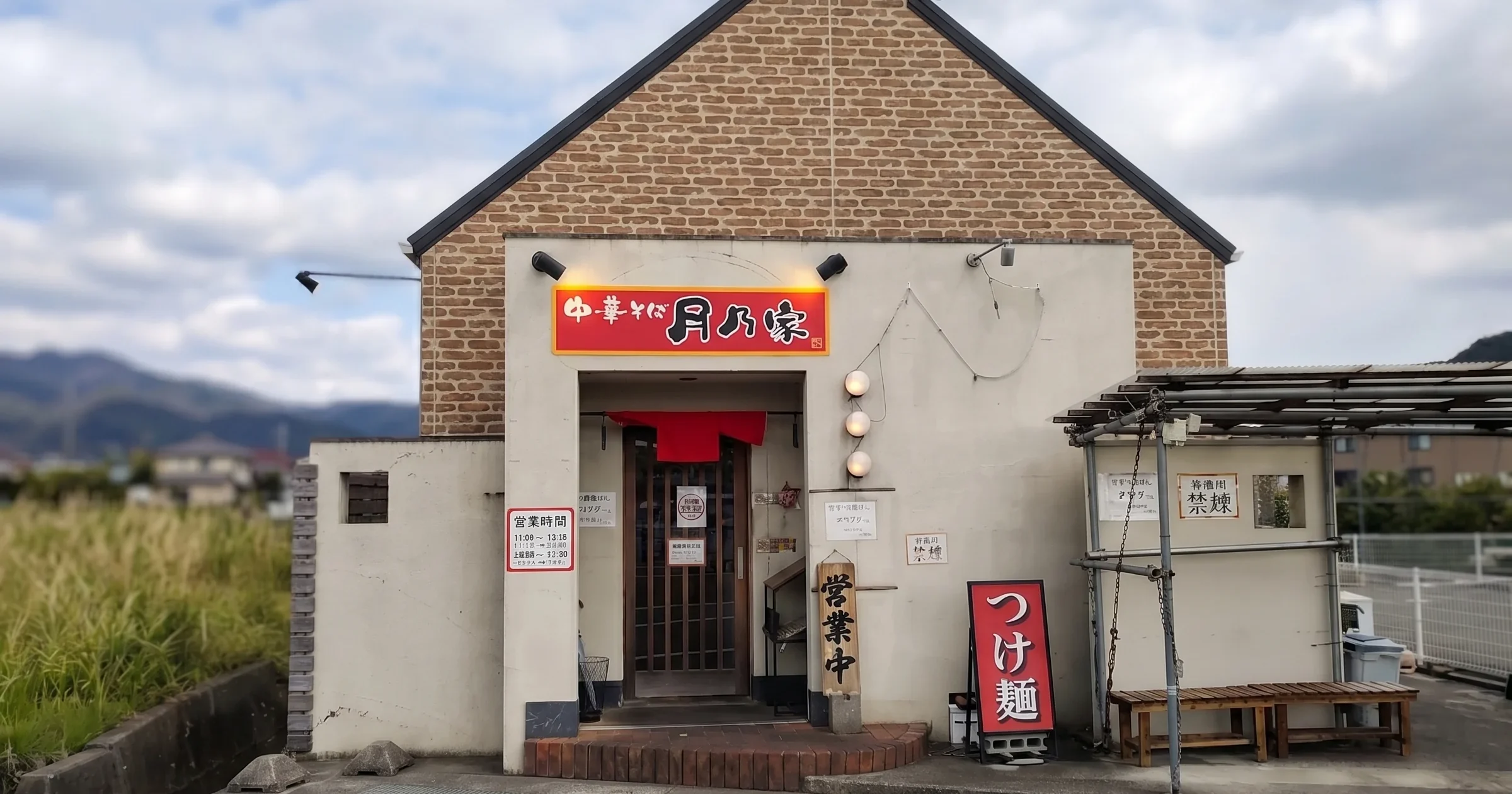
In Tenma, Aridagawa Town, Arida District—just a few minutes by car from the Arida IC on the Hanwa Expressway, directly across from Super Center Okuwa Aridagawa—stands a ramen shop called Mendining Tsukinoya.
It is a ramen restaurant selected for the Tabelog “Ramen WEST 100” in both 2023 and 2024.
The signature bowl is a rich tonkotsu-shoyu ramen called “New Wakayama Ramen” (shin-Wakayama Ramen), built on Yuasa soy sauce and Kirishima pork bone. Wakayama ramen has traditionally been described as a binary between the Ide lineage (cloudy, rich tonkotsu-shoyu) and the Shakomae lineage (clear shoyu), but Tsukinoya fits into neither, carving out its own distinctive position as a third path.
This is your complete guide to that single bowl and to the shop that serves it.
1. Mendining Tsukinoya: At a Glance
| Item | Detail |
|---|---|
| Name | Mendining Tsukinoya |
| Address | 428-1 Tenma, Aridagawa-cho, Arida District, Wakayama 643-0032 |
| Phone | +81-737-23-8661 |
| Lunch hours | 11:00–15:00 (L.O. 14:30) |
| Dinner hours | 18:00–21:00 (L.O. 20:30) |
| Closed | Tuesdays |
| Parking | Available (in front of the shop + shared parking with Super Center Okuwa Aridagawa across the street) |
| Seats | 23 (5 counter + 12 table + 6 tatami) |
| Payment | Cash only (no credit cards, electronic money, or QR-code payment) |
| Official website | Tabelog official page |
| Google Maps | Open in Maps |
| Official X | None |
| Official Instagram | @tsukinoya20200101 |
| Official Facebook | None |
| Founded | April 2009 |
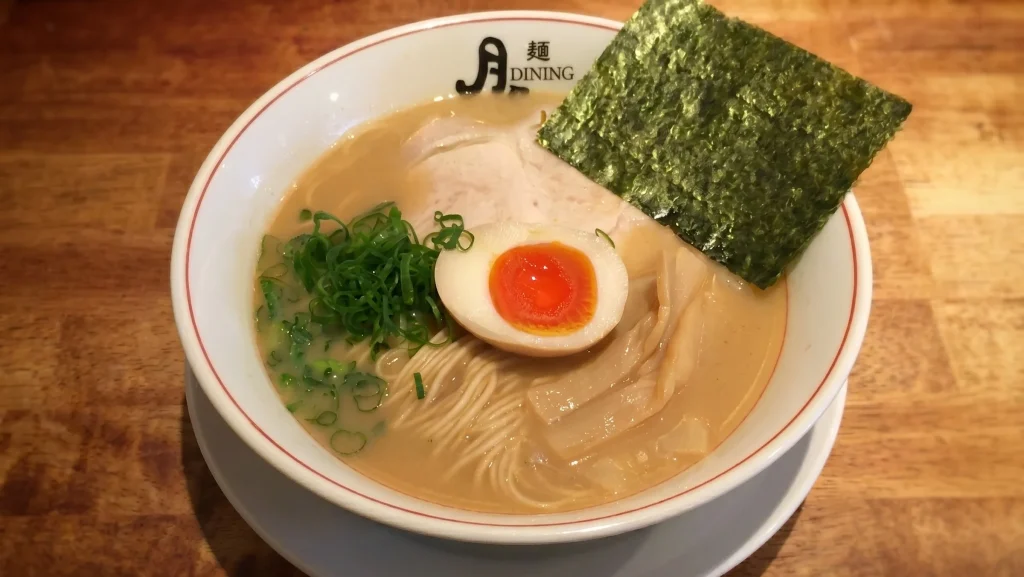
2. The Signature Bowl: Tonkotsu-Shoyu (“New Wakayama Ramen”)
Tsukinoya’s signature is a rich tonkotsu-shoyu ramen called “New Wakayama Ramen” (shin-Wakayama Ramen), built on Yuasa soy sauce and Kirishima pork bone.
Wakayama ramen has traditionally been framed as a binary between the Ide lineage (cloudy, rich tonkotsu-shoyu) and the Shakomae lineage (clear shoyu), but Tsukinoya’s bowl fits into neither category—it represents a third path the shop has assembled on its own terms.
The broth is composed of:
- Animal stock: A rich broth based on Kirishima pork bone (tonkotsu) from Kyushu
- Kaeshi (seasoning base): Yuasa soy sauce from Wakayama Prefecture (Yuasa Town is known as the birthplace of soy-sauce brewing in Japan, recognized through the Japan Heritage “First Drop”)
- Noodles: Thin straight noodles from Menya Teigaku, a noted noodle-maker in Kyoto
- Toppings: Chashu, menma, green onion, seasoned egg (with variations)
The menu also offers a Japanese-style tonkotsu called “Gekko” (literally “moonlight”), one of several variations selectable to taste—a bowl that pairs the pork-bone base with seafood elements such as mackerel-flake.
Regular Menu (verified March 2026)
| Item | Price |
|---|---|
| Tonkotsu-Shoyu (New Wakayama Ramen) | from 920 yen |
| Tonkotsu-Shio | from 920 yen |
| Chashu-men | from 1,240 yen |
| Tokuno (extra-rich) | from 1,030 yen |
| Tori-paitan (chicken) | from 980 yen |
| Gekko (Japanese-style tonkotsu) | from 930 yen |
| Tokuno Tsukemen | from 1,180 yen |
| Amauma Tsukemen | from 1,180 yen |
| Shrimp Tsukemen | from 1,180 yen |
| Mazesoba | from 1,180 yen |
Each ramen is also offered in seasoned-egg, chashu, and tokusei (deluxe) variations. Side dishes extend beyond the typical ramen-shop range, including shirasu (whitebait) rice, karaage (fried chicken), and shrimp spring rolls.
Seasonal limited bowls also appear throughout the year. The most reliable source for current limited offerings is the official Instagram (@tsukinoya20200101) (no official X or Facebook).
Note: Prices verified March 2026. Confirm the latest information via the official Instagram or in person.
3. The History of Tsukinoya
Tsukinoya was founded in April 2009 by Kanako Kuriyama in Tenma, Aridagawa Town. After serving as owner for ten years, Kuriyama handed the shop over to her apprentice in 2019.
The location is just a few minutes by car from the Arida IC on the Hanwa Expressway, directly across from Super Center Okuwa Aridagawa. Its prime spot along a major road draws not only locals but also visitors from around Fujinami Station on the JR Kisei Line, from Yuasa and Hirogawa areas, and many food enthusiasts who come by expressway from Wakayama City and Osaka.
As suggested by the format name “Mendining,” the shop steps beyond a strictly ramen-focused operation, adopting a teishoku-leaning style with side dishes such as shirasu rice, karaage, and shrimp spring rolls.
In terms of recognition, Tsukinoya was selected for the Tabelog “Ramen WEST 100″—the top 100 ramen shops in western Japan—in both 2023 and 2024. Many food enthusiasts from outside the prefecture make the trip as well.
4. Visitor Voices
Voice 1: Tokuno (@ryochin160)
A post (December 2024) noting “the sharp shoyu and the umami of the tonkotsu strike an exquisite balance—irresistible.” The visitor adds, “Tokuno and tsukemen sell out early, so go sooner rather than later,” and “no matter how many times I eat it, it’s delicious,” noting that all three members of the visiting party ordered Tokuno. A Voice that highlights an extra-rich variation of the signature tonkotsu-shoyu.
Voice 2: Amauma Tsukemen (@ramen.from_wakayama)
A post (April 2026) noting “a rich, almost gooey tonkotsu-shoyu dipping broth.” The visitor describes the dipping broth as “the shoyu kaeshi is more carefully crafted than in a typical rich tsukemen, giving a sweet-and-savory flavor that’s delicious,” and the noodles as “thick straight noodles with a smooth, chewy mouthfeel.” The post also touches on availability, noting “the rich-broth bowls such as tsukemen and Tokuno can sell out early.”
Voice 3: Gekko (Japanese-Style Tonkotsu) (@aki7924)
A post (September 2025) noting “a light tonkotsu paired with punchy mackerel-flake—a soup that is delicate yet has solid depth.” The visitor adds, “the medium-thin straight noodles with their crisp bite are also delicious,” and points out, “Gekko, a standard menu item that often gets overshadowed by rich-broth tsukemen and Tokuno on social media, deserves attention.”
Voice 4: Mazesoba (@yuchanchan1203)
A post (January 2026) noting “I had mazesoba for the first time in a while.” The visitor describes how they “mixed it up well,” found it “sweet, spicy, and delicious,” enjoyed the “follow-up rice (oimeshi),” and adds, “the portion was generous—I left full.”
Voice 5: Hiyashi Chuka (Cold Ramen) (@ramen__sukidesunen)
A post (August 2025) captioned simply “Mendining Tsukinoya — Hiyashi Chuka.” Although the caption is brief, naming only the menu item and the shop’s location, the photo captures one of Tsukinoya’s seasonal limited bowls served in summer.
5. Getting There
By Public Transportation
- About 20 minutes’ walk (about 1.5 km) from Fujinami Station on the JR Kisei Line
- From Osaka Station, the JR Limited Express Kuroshio reaches Fujinami Station in approximately 1 hour 20 minutes
- Service on the Kisei Line is limited, so checking the timetable in advance is recommended
By Car
- About 5 minutes by car from the Arida IC on the Hanwa Expressway / Yuasa-Gobo Toll Road
- About 1 hour 30 minutes from central Osaka
- About 1 hour 10 minutes from Kansai International Airport
Parking
Parking spaces are available in front of the shop, and shared parking with Super Center Okuwa Aridagawa across the street is also usable (noted across multiple sources). The lot can fill at peak times (weekend lunches), so an early visit is recommended.
Map
6. Eight Sights Worth a Side Trip Nearby
Pair your visit to Tsukinoya with a stop at one of these tourist destinations in the Aridagawa, Yuasa, Hirogawa, or Kainan areas. Below are eight picks listed roughly in order of proximity.
- Yuasa Shōyu Marushin Honke (Yuasa Town, about 7 minutes by car) — A soy sauce brewery founded in 1881 , with bottlings honored at the Monde Selection Grand Gold Award (its Nama-ippon Kuromame entry has won every year since 2006). As a constituent property of the Japan Heritage “First Drop,” the brewery offers tours and hands-on experiences of traditional cedar-barrel soy-sauce making. (Official Site / Yuasa Town Tourism Association / Google Maps)
- Yuasa Important Preservation District for Groups of Traditional Buildings (Yuasa Town, about 8 minutes by car) — A nationally selected Important Preservation District for Groups of Traditional Buildings (2006), designated under the “brewing town” category and the only such district in Wakayama Prefecture (approx. 6.3 ha, about 400 m east-west by 280 m north-south). As the birthplace of Japanese soy sauce, it is also the stage of the Japan Heritage story “The First Drop: Kishū Yuasa, Birthplace of Soy Sauce Brewing” (certified 2017). Within the grid of “tōri” (main streets) and “shōji” (narrow lanes), Edo- to modern-era townhouses with white-plastered kura (storehouses), tsushi-nikai (low second floors), latticed doors, and “mushiko-mado” (insect-cage windows) stand densely together, including the long-established soy sauce brewery Kadochō (founded 1841) and the kinzanji-miso maker Ōta Kyūsuke Ginsei. The Kumano Kodō pilgrimage route cuts through the district, and strolling stops such as Daisenbori (the inner harbor once used for shipping soy sauce) and Jinburo (a museum converted from a former public bathhouse) let visitors breathe in the lingering aroma of brewing. (Official Site / Wakayama Prefecture Official Tourism Site / Yuasa Town Tourism Association / Google Maps)
- Kadochō Soy Sauce Brewery (Yuasa Town, about 8 minutes by car) — Founded in 1841 , the only brewery in Yuasa Town that continues to produce soy sauce in its historic structures today. Eleven of its structures—the main hall, brewing storehouse, soy sauce storehouse, kōji-muro (koji room), grain storehouse, and others—were collectively designated as “Kadochō (Kanō Family Residence)” Important Cultural Properties of Japan in 2022, and as a constituent property of the Japan Heritage “First Drop,” Kadochō embodies the birthplace of Yuasa soy sauce. (Official Site / Yuasa Town Tourism Association / Google Maps)
- Washigamine Cosmos Park (Aridagawa Town, about 12 minutes by car) — A park spread across a 586-meter summit where cosmos flowers blanket the slopes in autumn. The site offers a 360-degree panorama stretching to Awaji Island, Shikoku, and the Kii Channel. (Wakayama Prefecture Official Tourism Site / Google Maps)
- Semuiji Temple (Yuasa Town, about 10 minutes by car) — An ancient temple founded in 1231 by Yuasa Kagemoto (grandson of Yuasa Munesige), with the priest Myōe-shōnin invited as its founding abbot. The temple’s foundational Yuasa Kageki dedication letter (Shihon Bokusho Okibumi) is a National Important Cultural Property, and four buildings — the Main Hall, the Founder’s Hall, the Bell Tower, and the Tutelary Shrine — are designated Wakayama Prefectural Cultural Properties. Also known as a celebrated cherry-blossom site, the precincts command sweeping views of Yuasa Bay. (Yuasa Town Tourism Association / Google Maps)
- Inamura-no-Hi-no-Yakata (Tsunami Education Center) (Hirogawa Town, about 12 minutes by car) — A disaster-education facility commemorating Hamaguchi Goryō, who set fire to his rice-straw stacks during the 1854 Earthquake to guide villagers to safety from the tsunami. The historical event behind the UN-designated World Tsunami Awareness Day (November 5), the site received the “NIPPON Disaster-Prevention Heritage” excellence award in 2024. (Official Site / Wakayama Prefecture Official Tourism Site / Japan Heritage: Hyakusei no Ando / Google Maps)
- Jizōbuji Temple (Kainan City, about 18 minutes by car) — An ancient temple whose precincts include the “Fujishiro Tōge Ōji-ato,” a site on the Kumano Kodo. Both the main hall and its principal image, a stone seated statue of Jizō Bodhisattva, are designated Important Cultural Properties of Japan. The “Gosho-no-Shiba” lawn behind the temple is celebrated as a scenic viewpoint commanding vistas from Wakanoura to Awaji Island, and the Ōji-ato is also a constituent property of the National Historic Site “Kumano Pilgrimage Route: Kii-ji.” (Kainan City Tourism Association / Google Maps)
- Zenpuku-in Shaka-dō (Kainan City, about 22 minutes by car) — A temple founded in 1214 by the Zen master Eisai, whose present Shakadō (Shakyamuni Hall) is said to have been built around 1327. It is a Zen-style Buddha hall — three bays wide by three bays deep, with a hipped roof and hongawara tile roofing — and, alongside the Buddha hall of Kōzan-ji in Yamaguchi Prefecture, it is designated a National Treasure as one of Japan’s oldest surviving Zen-style structures. Inside, the hall retains hiuchi-bari (fire-strike beams) characteristic of Zen-style architecture along the Seto Inland Sea, conveying the late Kamakura-period Zen idiom to the present day. (Kainan City Tourism Association / Google Maps)
7. Wakayama Ramen — Mainstream and Alternative Paths
Tsukinoya stands on a third path that fits neither side of Wakayama ramen’s traditional binary (the Ide and Shakomae lineages). To experience both the mainstream of Wakayama ramen and its alternative paths, the following celebrated shops also deserve a visit.
- Ide Shoten (Wakayama City) — The historic shop that introduced Wakayama ramen to the rest of Japan, the original tonkotsu-shoyu of the Ide lineage (cloudy, rich tonkotsu-shoyu)
- Wadining Seino Honten (Arida City) — Tabelog 100 selection for four consecutive years, known for “Kadochō Shoyu Takumi” and “Arida Black”—a clear-broth shoyu ramen
- Ramen Tanbo (Gobo City) — An alternative path: awarded Bib Gourmand in the Michelin Guide Kyoto · Osaka + Wakayama 2022. A precise shio (salt) ramen built from chicken and seafood
- ramen BIRDMAN (Gobo City) — An alternative path: Michelin Plate recognition. A rich tori-paitan (chicken-bone) bowl using Kinokuni mikan-dori chicken
- Honke Arochi Marutaka Chuka Soba (Wakayama City) — A long-established shop representing the “Shakomae” lineage of Wakayama ramen (clear shoyu)
8. What Is the Tabelog Ramen WEST 100 Selection?
The Tabelog “Ramen WEST 100” is an annual award that selects the top 100 ramen shops in western Japan (the Kinki, Chugoku, and Shikoku regions) based on high user evaluations on Tabelog. Aggregated from the vast volume of reviews posted on Tabelog, it is widely referenced within the ramen industry and among enthusiasts as an indicator that visualizes local food-lover support.
Mendining Tsukinoya is a Wakayama Prefecture ramen shop selected for the “Ramen WEST 100” in both 2023 and 2024.
9. Pre-Visit Final Checklist
- ✅ Hours: Lunch 11:00–15:00 (L.O. 14:30); dinner 18:00–21:00 (L.O. 20:30)
- ✅ Closed: Tuesdays
- ✅ Parking: In front of the shop + shared with Okuwa across the street; may fill at peak times
- ✅ Payment: Cash only (no credit cards, electronic money, or QR-code payment)
- ✅ Limited menus and current prices: Best confirmed via official Instagram @tsukinoya20200101 (no official X or Facebook)
- ✅ Peak-time waits: Weekend lunches can fill the seats; weekday lunches and early dinner hours tend to be relatively open
10. In Closing:A Wakayama Ramen on a Third Path
A rich tonkotsu-shoyu “New Wakayama Ramen” built on Yuasa soy sauce and Kirishima pork bone, alongside a wide range from shrimp tsukemen to mazesoba. As a third path that fits neither lineage of Wakayama ramen’s traditional pedigree, Tsukinoya was selected for the Tabelog “Ramen WEST 100” in both 2023 and 2024 and enjoys broad support from local food enthusiasts to Tabelog users from outside the prefecture.
When your travels bring you to the Aridagawa area, this is the bowl to seek out.
Last updated: May 4, 2026
Author: Wakayama Foodie Editorial Team
Published by: Wakayama Foodie