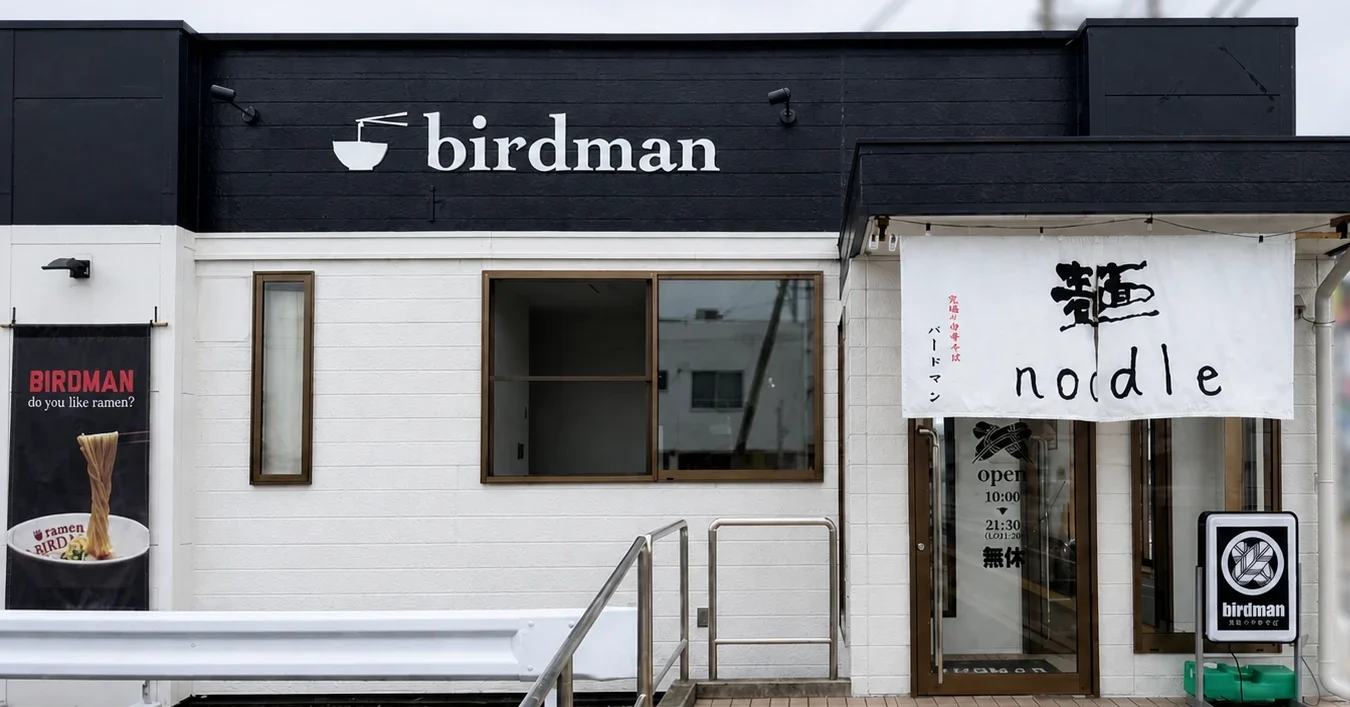
In Sono, Gobo City — relocated to the former Yoshinoya building in July 2025, adjacent to Kii-Gobo Station on the Kishu Railway, and about 10 minutes by car from the Gobo IC on the Yuasa-Gobo Toll Road — stands a ramen shop called ramen BIRDMAN.
Awarded Michelin Plate in the Michelin Guide Kyoto · Osaka + Wakayama 2022, BIRDMAN is a rich tori-paitan (chicken-bone) ramen restaurant in the Gobo area. Its signature “Nokō Tori SOBA” at 950 yen is known as a bowl that pairs Kinokuni mikan-dori — a Kishu-region branded local chicken — with Yuasa soy sauce.
This is your complete guide to the shop, its signature bowl, access, and visitor voices.
1. ramen BIRDMAN: At a Glance
| Item | Detail |
|---|---|
| Name | ramen BIRDMAN (Honten / Gobo Shop) |
| Address | 73-1 Sono, Gobo City, Wakayama 644-0002 |
| Phone | +81-70-8990-0713 |
| Hours | 10:00–21:30 (L.O. 21:20), continuous service |
| Closed | Irregular (please confirm via official Instagram (@ramenbirdman)) |
| Parking | Available (around the shop; please confirm capacity) |
| Seats | About 15 counter seats + box seats (please confirm) |
| Payment | Cash only (ticket-vending machine) |
| Official website | ramenbirdman.com |
| Google Maps | Open in Maps |
| Official X | @birdman1413 |
| Official Instagram | @ramenbirdman |
| Official Facebook | Ramen Birdman |
| Founded | 2014 |
2. The Signature Bowl: Nokō Tori SOBA, 950 yen
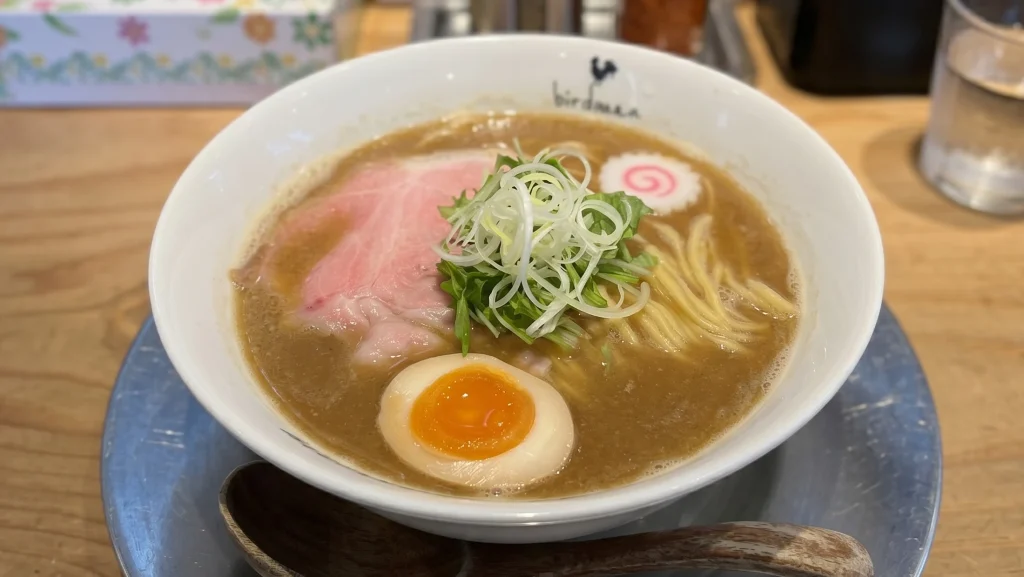
BIRDMAN’s signature is the standard “Nokō Tori SOBA” at 950 yen.
The broth places at its core Kinokuni mikan-dori — a Kishu-region branded local chicken — and is composed by pairing it with an original kaeshi (seasoning base) made from Yuasa soy sauce. The bowl is rounded out with custom noodles co-developed by the shop and a noodle-maker.
The broth is composed of:
- Lead chicken: Kinokuni mikan-dori, a Kishu-region branded local chicken
- Animal stock: A small amount of pork knuckle
- Aromatic vegetables: A blend of several varieties
- Kaeshi: An original seasoning base made from Yuasa soy sauce
- Noodles: Custom noodles from Naruto Seimensho
Regular Menu (as of July 2025)
| Item | Price |
|---|---|
| Nokō Tori SOBA Shoyu | 950 yen |
| Nokō Tori SOBA Shio | 950 yen |
| RED CHICKEN | from 1,000 yen |
| WHITE CHICKEN | 1,000 yen |
| Shamo-rock Chuka Soba | 1,000 yen |
| Shamo-rock Truffle | 1,100 yen |
| Ultimate Shio with Clam and Truffle | 1,100 yen |
| Jiro-man | 1,100 yen |
| Mazesoba | 880 yen |
| Mazesoba RED | 930 yen |
A new monthly limited bowl is also offered. The most reliable sources for current limited offerings are the official X (@birdman1413), the official Instagram (@ramenbirdman), and the official Facebook.
Note: Prices as of July 2025. Confirm the latest information via the official SNS (X / Instagram / Facebook) or in person.
3. The Shop’s Background
BIRDMAN was founded in 2014 in Sono, Gobo City. Operated as a shop centered on tori-paitan (chicken-bone) ramen, it is widely recognized for the logo that adopts its English-language shop name “BIRDMAN” verbatim.
In June 2021, the shop opened “BIRDMAN Wakayama” in Jūni-banchō, Wakayama City. While the main shop serves rich tori-paitan, the Wakayama branch offers a clear chicken-broth (tori-seitan) lineage (please confirm).
The location is adjacent to Kii-Gobo Station on the Kishu Railway, alongside National Route 42 next to GEO Gobo, and about 10 minutes by car from the Gobo IC on the Yuasa-Gobo Toll Road. In addition to local customers, the shop is known to draw visitors traveling in from the wider Kansai region.
4. Visitor Voices
Voice 1: Limited May Niboshi no Awa-Paitan (@ryochin160)
A post (May 2024) noting “the niboshi (dried-sardine) is a great match for the rich tori-paitan broth.” The visitor adds, “with that niboshi presence and the gritty texture of the fish powder, it’s a bowl niboshi lovers can’t resist,” and “because it’s a foam-style soup, the broth feels gentle on the palate,” highlighting the May-limited Niboshi no Awa-Paitan (foam-style chicken-bone soup with niboshi).
Voice 2: RED CHICKEN Spicy, 950 yen (@nooooodle.365)
A post (June 2025) noting “the spiciness of the RED layered onto the rich tori-paitan is addictive.” The visitor adds, “the thick broth clings beautifully to the noodles — incredibly rich,” and “I felt anew that this is a popular bowl,” recording a visit on the final day of business at the previous Gobo location, where they chose the signature RED CHICKEN Spicy.
Voice 3: Limited June Hyōketsu Shio Ramen (@komugi_ramen)
A post (June 2025) noting “the interior was a stylish, BAR-like, grown-up space — wonderful.” The visitor adds, “the clear shio broth is even better because the dashi-ice doesn’t dilute the flavor,” and “the tightly chilled noodles had great chew — superb,” describing the summer-limited Hyōketsu Shio Ramen (frozen-dashi shio ramen) as “a refreshing cold ramen perfect for hot days.”
Voice 4: Shamo-rock Chuka Soba (@jima29)
A post (September 2025) noting “stopped by ‘ramen BIRDMAN,’ a regular pick whenever I’m in Gobo.” The visitor describes the bowl as “a light chicken-broth shio with a generous helping of toppings — really delicious,” and adds, “the new location is on a main road with a much larger parking lot, so it’s easier to get to,” touching on the post-relocation environment. This visit marked the first order of the Shamo-rock.
Voice 5: Nokō Tori SOBA Shio (@mituguramu)
A post (April 2026) noting “I usually go shoyu, so today I went with shio. Shio is also great.” The visitor adds, “I enjoyed it thoroughly,” highlighting the shio version of the signature Nokō Tori SOBA.
5. Getting There
By Public Transportation
- Take the JR Kisei Line to Gobo Station, then transfer to the Kishu Railway
- Adjacent to Kii-Gobo Station on the Kishu Railway (relocated to the former Yoshinoya building in July 2025; for the most accurate walking time, please confirm via official Instagram (@ramenbirdman))
- From Osaka Station, the JR Limited Express Kuroshio reaches Gobo Station in approximately 1 hour 50 minutes
Note: The Kishu Railway is a small private railway in Wakayama Prefecture. Service is limited, so checking the timetable in advance is recommended.
By Car
- About 10 minutes via the southbound exit of the Gobo IC on the Hanwa Expressway / Yuasa-Gobo Toll Road
- About 1 hour 40 minutes from central Osaka
Parking
Parking spaces are available around the shop (capacity and layout to be confirmed). The lot can fill at peak times (weekend lunches), so an early visit with time to spare is recommended.
Map
6. Eight Sights Worth a Side Trip Nearby
Pair your visit to ramen BIRDMAN with a stop at one of these tourist destinations in the Gobo, Hidakagawa, Yura, Yuasa, or Hirogawa areas. Below are eight picks listed roughly in order of proximity.
- Shino Hachiman Shrine (Gobo City, about 3 minutes by car) — The tutelary shrine of Gobo City, whose annual October festival “Gobo Matsuri” is the largest festival in the Hidaka region. The shrine’s Kehon Odori (Gibyō Odori) ritual dance is the No. 1 designated Intangible Folk Cultural Property of Wakayama Prefecture and is also designated as a Selected Intangible Folk Cultural Property of Japan. (Official Site / Google Maps)
- Enjugahama Beach (Mihama Town, about 7 minutes by car) — Part of Enjukaigan Prefectural Natural Park, where a black pine forest and pebble beach extend for about 4.6 km. Selected for both the “100 Best White Sand and Green Pine” sites and the “100 Best Sunrises and Sunsets of Wakayama Prefecture.” (Official Site / Wakayama Prefecture Official Tourism Site / Google Maps)
- Dōjōji Temple (Hidakagawa Town, about 8 minutes by car) — Founded in 701 CE, the oldest temple in Wakayama Prefecture. Known as the sacred site of the Anchin–Kiyohime legend — the source story for the Noh and Kabuki plays “Dōjōji” — the temple houses a group of National Treasure and Important Cultural Property Buddhist statues. (Official Site / Wakayama Prefecture Official Tourism Site / Hidakagawa Town Tourism Association / Google Maps)
- Kōkokuji Temple (Yura Town, about 18 minutes by car) — Founded in 1227 by Katsurayama Kagetomo (Gansei, a vassal of Minamoto no Sanetomo) as a Shingon-sect temple called “Saihōji.” In 1258, the priest Hōtō Kokushi (Kakushin) was invited as founding abbot (kaisan), and Kakushin himself changed the temple to the Zen school; in 1340, Emperor Go-Murakami granted the temple name “Kōkokuji.” Also known as the Japanese birthplace of Kinzanji miso, soy sauce, and the shakuhachi (bamboo flute, via the komusō monks). (Wakayama Prefecture Official Tourism Site / Yura Town Tourism Association / Google Maps)
- Shirasaki Ocean Park (Yura Town, about 25 minutes by car) — A scenic coast where the contrast between capes of chalk-white limestone and deep indigo seas has earned it the nickname “the Aegean of Japan.” The limestone formed roughly 250 million years ago in the Permian period of the Paleozoic era, and fossils of fusulinids and crinoids can be spotted throughout the outcrops. The park lies within the Shirasaki Coast Prefectural Natural Park and is also one of Japan’s “100 Best Shorelines” (selected in 1996 by the Dai-Nippon Fisheries Society and others). On site, visitors will find observation decks, an auto-camping ground, and a Michi-no-Eki roadside station (serving shirasu-don and Shirasaki curry), while the photo spot where Hijiki-jima (Sea-Weed Island) nestles neatly inside the rock arch of Tategan-iwa is a popular draw. (Official Site / Wakayama Prefecture Official Tourism Site / Yura Town Tourism Association / Google Maps)
- Inamura-no-Hi-no-Yakata (Tsunami Education Center) (Hirogawa Town, about 25 minutes by car) — A disaster-education facility commemorating Hamaguchi Goryō, who set fire to his rice-straw stacks during the 1854 Earthquake to guide villagers to safety from the tsunami. The historical event behind the UN-designated World Tsunami Awareness Day (November 5), the site received the “NIPPON Disaster-Prevention Heritage” excellence award in 2024. (Official Site / Wakayama Prefecture Official Tourism Site / Japan Heritage: Hyakusei no Ando / Google Maps)
- Yuasa Shōyu Marushin Honke (Yuasa Town, about 28 minutes by car) — A soy sauce brewery founded in 1881 , with bottlings honored at the Monde Selection Grand Gold Award (its Nama-ippon Kuromame entry has won every year since 2006). A constituent property of the Japan Heritage “First Drop.” (Official Site / Yuasa Town Tourism Association / Google Maps)
- Kadochō Soy Sauce Brewery (Yuasa Town, about 28 minutes by car) — Founded in 1841 , the only brewery in Yuasa Town that continues to produce soy sauce in its historic structures today. Eleven of its structures — the main hall, brewing storehouse, soy sauce storehouse, kōji-muro (koji room), grain storehouse, and others — were collectively designated as “Kadochō (Kanō Family Residence)” Important Cultural Properties of Japan in 2022, and as a constituent property of the Japan Heritage “First Drop.” (Official Site / Yuasa Town Tourism Association / Google Maps)
7. Wakayama Ramen — Mainstream and Alternative Paths
BIRDMAN sits on the tori-paitan (chicken-bone) lineage, on a separate axis from the mainstream of Wakayama ramen (the Ide-lineage tonkotsu-shoyu). Tasting and comparing other celebrated shops in the prefecture brings the breadth of Wakayama ramen into three-dimensional view.
- Ide Shoten (Wakayama City) — The historic shop that introduced Wakayama ramen to the rest of Japan, the original tonkotsu-shoyu of the Ide lineage
- Mendining Tsukinoya (Aridagawa Town) — Tabelog “Ramen WEST 100” selection; a rich tonkotsu-shoyu “New Wakayama Ramen” built on Yuasa soy sauce and Kirishima pork bone
- Wadining Seino Honten (Arida City) — Tabelog 100 selection plus Michelin Bib Gourmand recognition; a clear-broth shoyu ramen known for “Kadochō Shoyu Takumi” and “Arida Black”
- Ramen Tanbo (Gobo City) — Awarded Bib Gourmand in the Michelin Guide Kyoto · Osaka + Wakayama 2022. A precise shio (salt) ramen built from chicken and seafood
- Honke Arochi Marutaka Chuka Soba (Wakayama City) — A long-established shop representing the “Shakomae” lineage of Wakayama ramen (clear shoyu)
8. Michelin Plate and the Gobo Ramen Context
Michelin Plate (The Plate Michelin) is a designation awarded by the Michelin Guide to restaurants that “serve carefully prepared, delicious dishes using quality ingredients.” It is a separate evaluation category from stars (★) or Bib Gourmand (cost-performance), given to establishments the Michelin inspectors judge worthy of inclusion.
The Michelin Guide Kyoto · Osaka + Wakayama 2022 was the first Michelin guide to feature Wakayama Prefecture as a dedicated section. Within Gobo City, two shops were selected: Ramen Tanbo (Bib Gourmand) and ramen BIRDMAN (Plate).
9. Pre-Visit Final Checklist
- ✅ Hours: 10:00–21:30 (L.O. 21:20), continuous service
- ✅ Closed: Irregular (please confirm via official Instagram @ramenbirdman)
- ✅ Payment: Cash only, ticket-vending machine (no credit cards or electronic money)
- ✅ Parking: Around the shop; may fill at peak times
- ✅ Limited menus and current prices: Best confirmed via official site / X @birdman1413 / Instagram @ramenbirdman / Facebook
10. In Closing:A Michelin Plate Tori-Paitan in Gobo
A rich tori-paitan “Nokō Tori SOBA” at 950 yen built on Kinokuni mikan-dori and Yuasa soy sauce — the signature of a Michelin Plate-recognized chicken-bone ramen shop in Gobo City. The lineup also extends across a varied range of bowls, including RED CHICKEN, WHITE CHICKEN, Shamo-rock Truffle, and the Ultimate Shio with Clam and Truffle.
When your travels bring you to Gobo, this is the bowl to seek out for lunch.
Last updated: May 5, 2026
Author: Wakayama Foodie Editorial Team
Published by: Wakayama Foodie