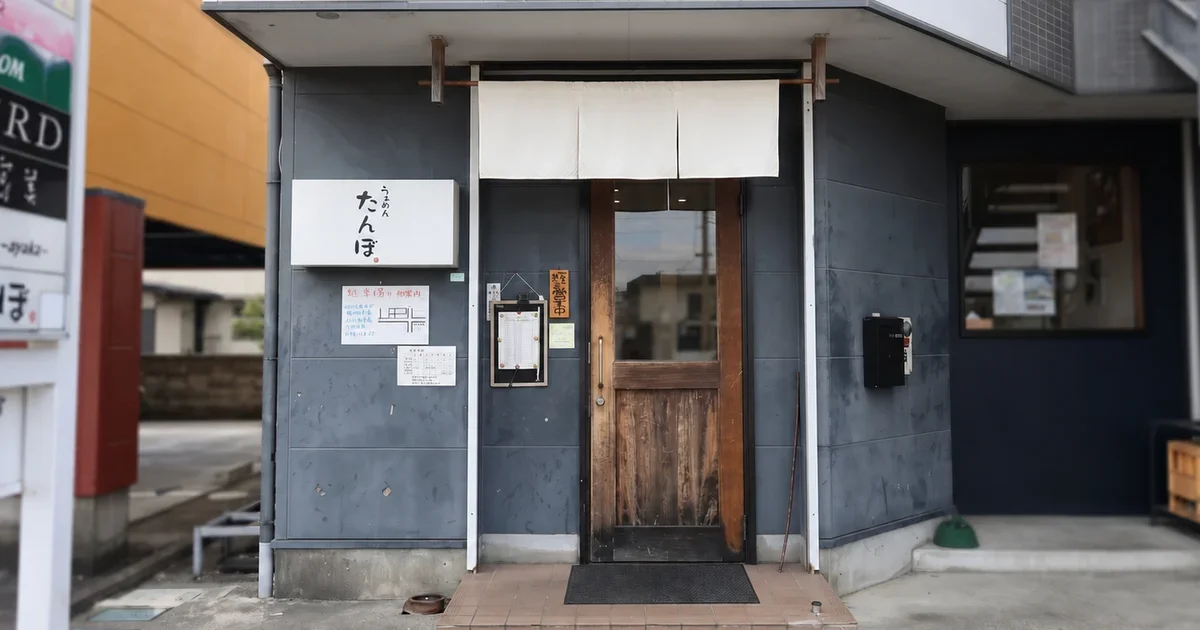
In Yukawa-cho, Gobo City, just ten minutes by car from the Gobo IC on the Yuasa-Gobo Toll Road, a small ramen shop tucked into a quiet residential block draws ardent attention from Wakayama’s food community as a Bib Gourmand-certified restaurant in the Michelin Guide Kyoto · Osaka + Wakayama 2022.
Its name: Ramen Tanbo.
The shop’s name simply reflects the surname of its owner, Shinji Tambo (田甫 伸司). The chef himself has stated in interviews that the shop’s name has nothing to do with the rice paddies (tanbo) that spread out in front of the restaurant.
After training at MIST—the Chabu-ya group’s Hong Kong branch and the world’s first Michelin-starred ramen shop—Tambo returned to Japan and opened his own restaurant in September 2014 in Gobo City, near his hometown of Yura. While Wakayama’s ramen tradition is dominated by tonkotsu-shoyu in the Ide lineage, Tambo has charted a deliberately opposite course: a precise shio (salt) broth built from chicken and seafood. The result has earned him fervent local devotion.
This is your complete guide to a single bowl that has won so much respect.
1. Ramen Tanbo: At a Glance
| Item | Detail |
|---|---|
| Name | Ramen Tanbo |
| Address | 217-2 Takarabe, Yukawa-cho, Gobo City, Wakayama 644-0011 (1F Salambang Tenanto-haus) |
| Phone | +81-738-32-8333 |
| Lunch hours | 11:00–14:00 |
| Dinner hours | Tue · Wed 18:00–24:00 / Fri · Sat 18:00–25:00 / Sun 18:00–21:00 |
| Closed | Mondays (lunch only on national holidays); Thursday dinner |
| Parking | Approx. 20 spaces (in front of the shop + shared Salambang Tenanto-haus lot) |
| Seats | Approx. 20 (5 counter + 14 table; child-seat friendly) |
| Payment | Cash only |
| Official website | None |
| Google Maps | Open in Maps |
| Official X | @_mononofu_men |
| Official Instagram | @tamboshinji |
| Official Facebook | ramentanbo |
| Founded | September 2014 |
2. The Signature Bowl: Shio Ramen, 950 Yen
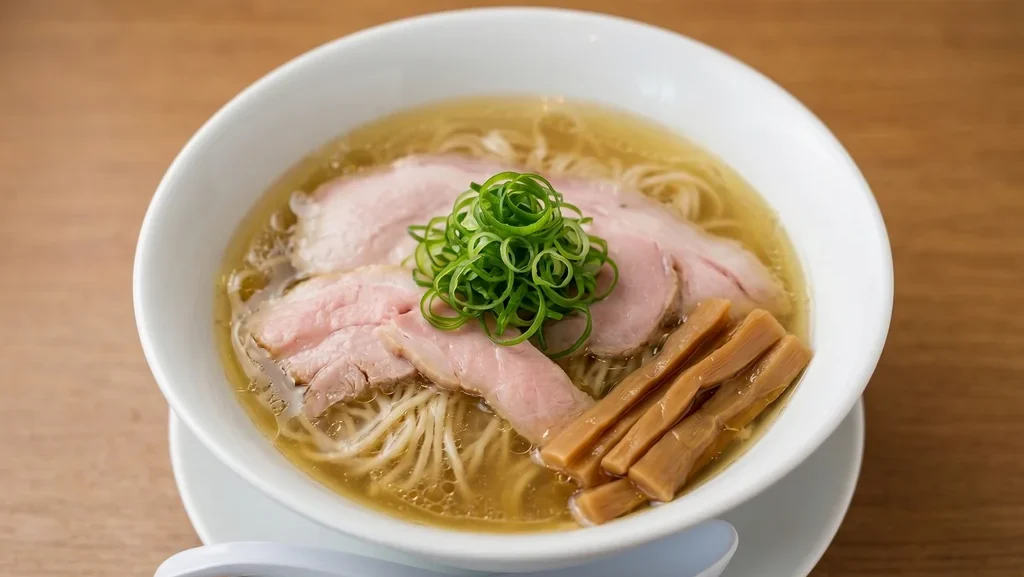
The undisputed star at Ramen Tanbo is the modestly named standard, Shio Ramen (salt-based ramen), 950 yen.
A first sip reveals the layered umami of chicken and seafood broth, followed by a clean burst of yuzu citrus that lingers across the palate.
The broth is composed of:
- Animal stock: Whole Awa-mi heritage chickens from Shiga Prefecture + Tenkudaio chicken bones from Kumamoto Prefecture + beef bones + aromatic vegetables
- Seafood stock: Clams, oysters, and sardine niboshi
- Shio kaeshi (seasoning base): A blend designed to draw out the maximum umami of each ingredient
- Yuzu citrus: A finishing brightness
These elements are slowly simmered and meticulously combined into a clear broth, then paired with house-made medium-thin straight noodles enriched with whole-wheat flour. The chashu uses both pork and chicken, while the menma, seasoned egg, and shrimp wonton (optional) are likewise produced from scratch—a thoroughgoing dedication that runs through every component of the bowl.
Regular Menu (verified September 2025)
| Item | Price |
|---|---|
| Shio Ramen | from 950 yen |
| Shoyu Ramen | from 950 yen |
| Tonkotsu Ramen | from 950 yen |
| Tantanmen (red / black) | 980 yen each |
| Soupless Tantanmen | 950 yen |
| Umami Soba (thick noodles) | from 1,000 yen |
| Shoyu Tsukemen (thick noodles) | from 1,000 yen |
Each ramen is also offered in umeshio (plum salt), seasoned-egg, tokusei (deluxe), shrimp-wonton, and chashu variations (up to ~1,300 yen).
Seasonal limited bowls appear regularly. Examples include the so-called “Jiro-style” bowl in April and chilled (hiyashi) bowls during summer—touches that keep regulars returning. The most reliable sources for current limited offerings are the official X (@_mononofu_men), official Instagram (@tamboshinji), or official Facebook.
Note: Prices verified September 2025. Confirm the latest information via the official SNS (X / Instagram / Facebook) or in person.
3. The Owner’s Story: From Surveyor to Hong Kong Michelin to Gobo
The deeper appeal of Ramen Tanbo lies in the path the chef himself has walked.
A Boy from Yura Discovers Ramen
Tambo was born in Yura, a coastal town in Hidaka District, Wakayama Prefecture. He worked as a land surveyor before his passion for ramen pulled him in another direction: three years of training in Tokyo, followed by a more decisive move.
To MIST, the World’s First Michelin-Starred Ramen Shop
Tambo’s next stop was Hong Kong.
Operated by the Chabu-ya group, MIST made history when the Michelin Guide Hong Kong · Macau awarded it a one-star rating—the world’s first ramen shop to earn a Michelin star, an event that sent shockwaves through the global ramen community.
For two years at MIST, Tambo absorbed the philosophy of star-grade ramen and the daily intensity of cooking for the world’s most discerning palates.
2014: Going Independent in Gobo
After completing his training, Tambo opened his own shop in September 2014 in Takarabe, Yukawa-cho, Gobo City—just a town away from his native Yura.
From day one, he chose a path apart from Wakayama’s ramen mainstream (the tonkotsu-shoyu of the Ide lineage), staking his identity on a precise chicken-and-seafood shio broth.
In 2022, that choice received its formal recognition: the inaugural Wakayama edition of the Michelin Guide named Ramen Tanbo a Bib Gourmand restaurant (see §8 for details).
The lineage of Hong Kong’s MIST has come to fruition in the Wakayama Michelin context—a story that stands as a small but vivid testament to the cross-border travel and inheritance of ramen culture, now etched into Wakayama’s culinary record.
4. Visitor Voices
Voice 1: Tokusei Tonkotsu Ramen, Reviewed by a Wakayama-Ramen Specialist (@ramen.from_wakayama)
A post (November 2024) noting “the tonkotsu broth is on the richer, oilier side; not viscous, yet garlic is well at work — an addictive deep flavor.” The visitor evaluates the noodles as “thin straight noodles with whole-wheat flour — though thin, they offer satisfying chew alongside a smooth slip down,” and adds of the pork-shank that takes the place of the standard chashu, “a solid block, yet tender, well-seasoned, and remarkably satisfying to eat.”
Voice 2: The Moment of Plating (@kinokuniyazentarou)
A Reel post (March 2026) captioned “Ramen Tanbo — 217-2 Takarabe, Gobo City, Wakayama; please give it a try.” The video presents the shop’s address, phone, hours, and parking information.
Voice 3: Summer’s “Hiyashi Tantan Black” (@ryochin160)
A post (May 2024) noting “the broth is well-chilled, with a deep sesame fragrance and a creamy texture; generous minced meat with nuts gives a well-balanced heat.” The visitor describes the noodles as “noodles with firm chew” and announces the summer-only return: “Tanbo’s much-loved chilled bowl is back this year — fans, please don’t miss it” (red or black selectable).
Voice 4: The Signature Shio and a Business Traveler’s Treat (@shigoto_to_yasumi)
A post (August 2025) noting “a clear shio broth that soaks straight into the body. Tender chashu, a sharply defined salt edge, lingering depth of flavor.” The visitor adds of the chashu-mayo rice that completes the set, “great volume, fully satisfying,” and describes this Bib Gourmand restaurant as “a secret pleasure on Gobo business trips.”
Voice 5: April-Only “Tanjiro” (@ra_men1114)
A post (April 2026) noting “the tonkotsu-shoyu broth is rich, and the shoyu kaeshi is delicious as well.” The visitor describes the noodles as “flat thick noodles with a hearty wash-wash bite and a smooth slurp,” and shares impressions of the April-only Jiro-style bowl “Tanjiro” (¥1,250).
5. Getting There
By Public Transportation
- Take the JR Kisei Line to Gobo Station, then transfer to the Kishu Railway (about 5 minutes)
- From Gakumon Station on the Kishu Railway, about 9 minutes’ walk (690 m) / from Kii-Gobo Station, about 10 minutes’ walk (760 m)
- From Osaka Station, the JR Limited Express Kuroshio reaches Gobo Station in approximately 1 hour 50 minutes
Note: The Kishu Railway is a small private line in Wakayama Prefecture. Service is infrequent, so checking the timetable in advance is strongly recommended.
By Car
- About 10 minutes by car from the Gobo IC on the Hanwa Expressway / Yuasa-Gobo Toll Road
- Approximately 1 hour 40 minutes from central Osaka
Parking
About 20 spaces in front of the shop, with overflow available at the shared Salambang Tenanto-haus lot. The lot can fill at peak times (weekend lunches).
Map
6. Eight Sights Worth a Side Trip Nearby
Pair your visit to Ramen Tanbo with one of these tourist destinations in the Gobo and Arida areas. Below are eight picks listed roughly in order of proximity.
- Shino Hachiman Shrine (Gobo City, about 5 minutes by car) — The tutelary shrine of Gobo City. Its annual October festival, Gobo Matsuri, is the largest festival in the Hidaka region; the Kehon-odori (Gyōhyō-odori) dance dedicated at the festival is the first Intangible Folk Cultural Property designated by Wakayama Prefecture and is also a Selected Intangible Folk Cultural Property of Japan. The shrine carries the rich folk culture and history of the old castle town and temple-town district into the present. (Official Site / Google Maps)
- Dōjō-ji Temple (Hidakagawa Town, about 8 minutes by car) — Founded in 701 CE, the oldest temple in Wakayama Prefecture. Sacred ground for the Anchin-Kiyohime legend that inspired the Noh and Kabuki play Dōjōji, with a remarkable collection of National Treasure and Important Cultural Property Buddhist statuary. Visitors can also listen to the temple’s traditional etoki (picture-scroll) sermons. (Official Site / Wakayama Prefecture Official Tourism Site / Hidakagawa Town Tourism Association / Google Maps)
- Enjugahama Beach (Mihama Town, about 8 minutes by car) — A 4.6 km stretch of black-pine forest and pebble shore designated as Enjukaigan Prefectural Natural Park, selected among Japan’s “100 White-Sand and Green-Pine Beaches” and “Wakayama’s 100 Sunrise/Sunset Spots.” An easily accessed coastal vista perfect for a post-ramen stroll in the sea breeze. (Official Site / Wakayama Prefecture Official Tourism Site / Google Maps)
- Kōkoku-ji Temple (Yura Town, about 20 minutes by car) — Founded in 1227 by Kazurayama Kagetomo (Gansei, a retainer of Minamoto no Sanetomo) as the Shingon-sect temple “Saihō-ji.” In 1258, Hottō Kokushi (Kakushin) was invited as founding abbot (kaisan), and Kakushin himself changed the temple to the Zen school, and in 1340 Emperor Go-Murakami granted the present temple name “Kōkoku-ji.” Known as the birthplace in Japan of kinzanji-miso, soy sauce, and the shakuhachi flute (and its komusō mendicant tradition), it is an indispensable stop for travelers tracing the cultural origins of Yuasa soy sauce. (Wakayama Prefecture Official Tourism Site / Yura Town Tourism Association / Google Maps)
- Shirasaki Ocean Park (Yura Town, about 25 minutes by car) — A scenic coast where the contrast between capes of chalk-white limestone and deep indigo seas has earned it the nickname “the Aegean of Japan.” The limestone formed roughly 250 million years ago in the Permian period of the Paleozoic era, and fossils of fusulinids and crinoids can be spotted throughout the outcrops. The park lies within the Shirasaki Coast Prefectural Natural Park and is also one of Japan’s “100 Best Shorelines” (selected in 1996 by the Dai-Nippon Fisheries Society and others). On site, visitors will find observation decks, an auto-camping ground, and a Michi-no-Eki roadside station (serving shirasu-don and Shirasaki curry), while the photo spot where Hijiki-jima (Sea-Weed Island) nestles neatly inside the rock arch of Tategan-iwa is a popular draw. (Official Site / Wakayama Prefecture Official Tourism Site / Yura Town Tourism Association / Google Maps)
- Inamura-no-Hi-no-Yakata (Tsunami Education Center) (Hirogawa Town, about 30 minutes by car) — A disaster-education facility commemorating Hamaguchi Goryō, who set fire to his rice-straw stacks during the 1854 Earthquake to guide villagers to safety from the tsunami. The historical event behind the UN-designated World Tsunami Awareness Day (November 5), the site received the “NIPPON Disaster-Prevention Heritage” excellence award in 2024. (Official Site / Wakayama Prefecture Official Tourism Site / Japan Heritage: Hyakusei no Ando / Google Maps)
- Yuasa Shōyu Marushin Honke (Yuasa Town, about 30 minutes by car) — A soy sauce brewery founded in 1881 , with bottlings honored at the Monde Selection Grand Gold Award (its Nama-ippon Kuromame entry has won every year since 2006). As a constituent property of the Japan Heritage “First Drop,” the brewery offers tours and hands-on experiences of traditional cedar-barrel soy-sauce making. (Official Site / Yuasa Town Tourism Association / Google Maps)
- Kadochō Soy Sauce Brewery (Yuasa Town, about 30 minutes by car) — Founded in 1841 , the only brewery in Yuasa Town that continues to produce soy sauce in its historic structures today. Eleven of its structures—the main hall, brewing storehouse, soy sauce storehouse, kōji-muro (koji room), grain storehouse, and others—were collectively designated as “Kadochō (Kanō Family Residence)” Important Cultural Properties of Japan in 2022, and as a constituent property of the Japan Heritage “First Drop,” Kadochō embodies the birthplace of Yuasa soy sauce. (Official Site / Yuasa Town Tourism Association / Google Maps)
7. Wakayama Ramen — Mainstream and Alternative Paths
Tanbo offers a refined “chicken plus seafood” shio (salt) ramen recognized with the Michelin Bib Gourmand. To experience both the mainstream of Wakayama ramen (the Ide and Shakomae lineages) and its alternative paths (such as tori-paitan, rich chicken-bone ramen), the following celebrated shops also deserve a visit.
- Ide Shoten (Wakayama City) — The historic shop that introduced Wakayama ramen to the rest of Japan, the original tonkotsu-shoyu of the Ide lineage
- Honke Arochi Marutaka Chuka Soba (Wakayama City) — A long-established shop representing the “Shakomae” lineage of Wakayama ramen
- Wadining Seino Honten (Arida City) — Michelin Bib Gourmand and Tabelog 100 selection for four consecutive years; the originator of “Arida Black”
- Mendining Tsukinoya (Aridagawa Town) — Tabelog “Ramen WEST 100” selection; rich tonkotsu-shoyu using Yuasa soy sauce and Kirishima pork (a third path that fits neither the Ide nor the Shakomae lineage)
- ramen BIRDMAN (Gobo City) — Michelin Plate recognition; rich tori-paitan using Kinokuni mikan-dori chicken (an alternative path)
8. What Is Michelin Bib Gourmand?
The Michelin Bib Gourmand designates restaurants that, in the Michelin Guide’s judgment, deliver “good value: a great meal at a moderate price.” The benchmark is roughly under 6,000 yen in Japan, or around 35–40 euros / dollars in Europe and the United States—restaurants whose food meets Michelin’s standards while remaining affordably priced.
The Michelin Guide Kyoto · Osaka + Wakayama 2022 was the first Michelin guide to feature Wakayama as a dedicated section. Of the 85 restaurants listed in Wakayama, 15 received Bib Gourmand recognition. Ramen Tanbo is one of those 15.
9. Pre-Visit Final Checklist
- ✅ Hours: Lunch 11:00–14:00; dinner hours vary by day of the week (please confirm)
- ✅ Closed: Mondays (lunch only on national holidays); Thursday dinner
- ✅ Payment: Cash only (no credit cards or electronic money)
- ✅ Parking: Approx. 20 spaces; may fill at peak times
- ✅ Limited menus and current prices: Best confirmed via official X @_mononofu_men / official Instagram @tamboshinji / official Facebook
10. In Closing:From Hong Kong Michelin to Home
Three lines—shio, shoyu, tonkotsu—built on devoted house-made noodles and meticulously composed broth. Take a single sip of the signature Shio Ramen, 950 yen, and the meaning of this story will resolve itself, quite literally, in your mouth.
When your travels bring you to Gobo, this is the bowl to seek out.
Last updated: May 2, 2026
Author: Wakayama Foodie Editorial Team
Published by: Wakayama Foodie