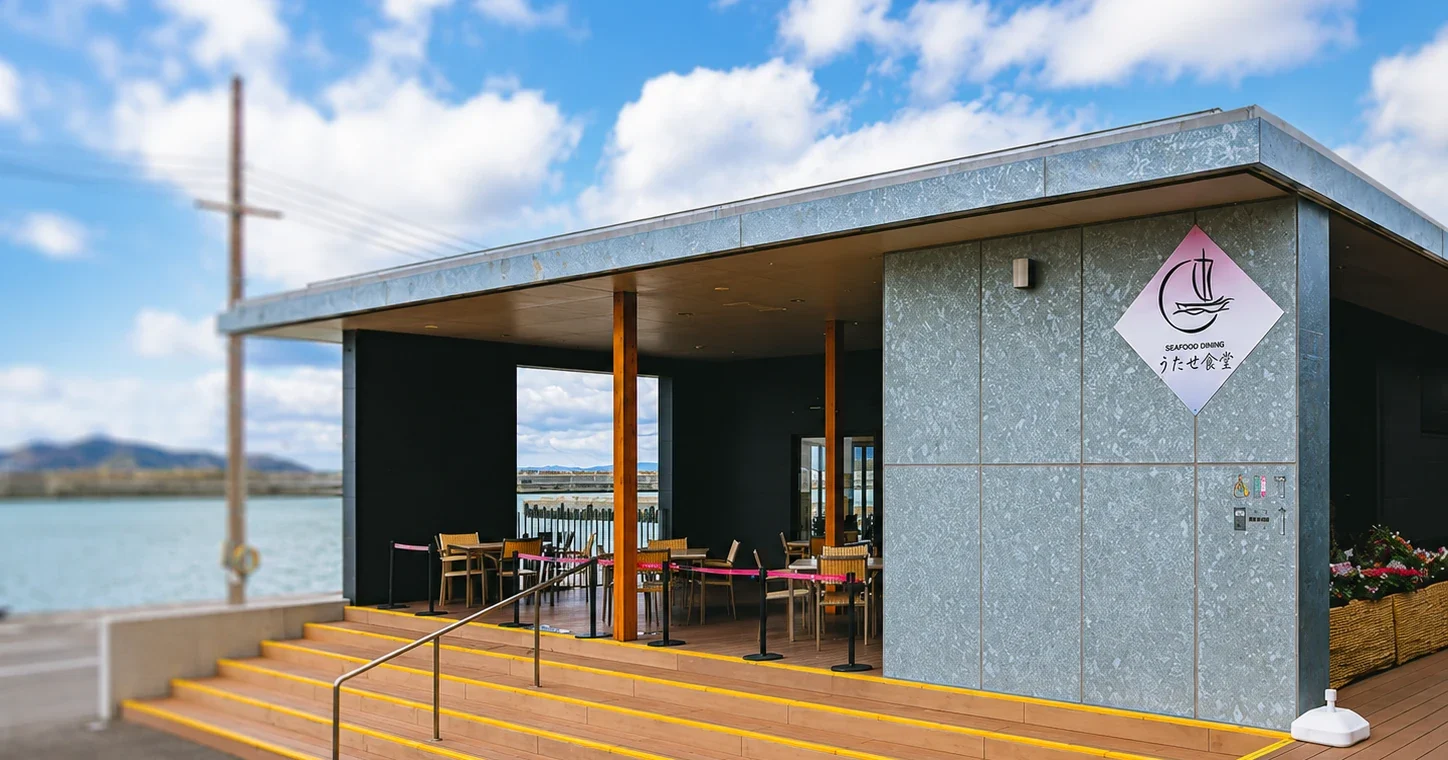
In Miyazaki-cho, Arida City — right alongside Mishima Fishing Port — Hama-no-Utase is a market diner and retail shop operated directly by the Mishima Fishery Cooperative. The facility opened in May 2020 and is featured as a recommended spot by the Arida City Tourism Association (Arida City Tourism Association Official).
Composed of two adjoining buildings — a retail hall and a dining hall — the site adopts a distribution model in which the fishery cooperative itself handles operations end-to-end. Free parking for more than 130 vehicles and traffic flow designed to accommodate large tour buses make the venue a stop that welcomes both local customers and drive-in visitors from the wider Kansai region.
This complete guide covers the venue information, main menu, access, and visitor voices in a single place.
1. Hama-no-Utase: At a Glance
| Item | Detail |
|---|---|
| Name | Hama-no-Utase |
| Address | 2489 Miyazaki-cho, Arida City, Wakayama 649-0316 |
| Phone | +81-737-23-7138 |
| Hours (retail hall) | 9:00–18:00 |
| Hours (dining hall) | 10:00–17:00 (meals 10:00–13:30; until 14:30 on weekends and holidays; drinks and soft-serve only thereafter) |
| Closed | Wednesdays (open when a Wednesday falls on a national holiday); New Year holidays |
| Parking | Available (free; more than 130 spaces) |
| Seats | 40 (20 indoors + 20 on the outdoor terrace) |
| Payment | Cash only (credit cards, e-money, and QR code payment not accepted) |
| Official website | hamano-utase.com |
| Google Maps | Open in Maps |
| Official X | @hamanoutase |
| Official Instagram | @hamanoutase |
| Official Facebook | hamanoutase |
| Founded | May 2020 |
2. The Signature Menu: Seasonal Kaisen-don and Tachiuo-Ebi Tempura Bowl
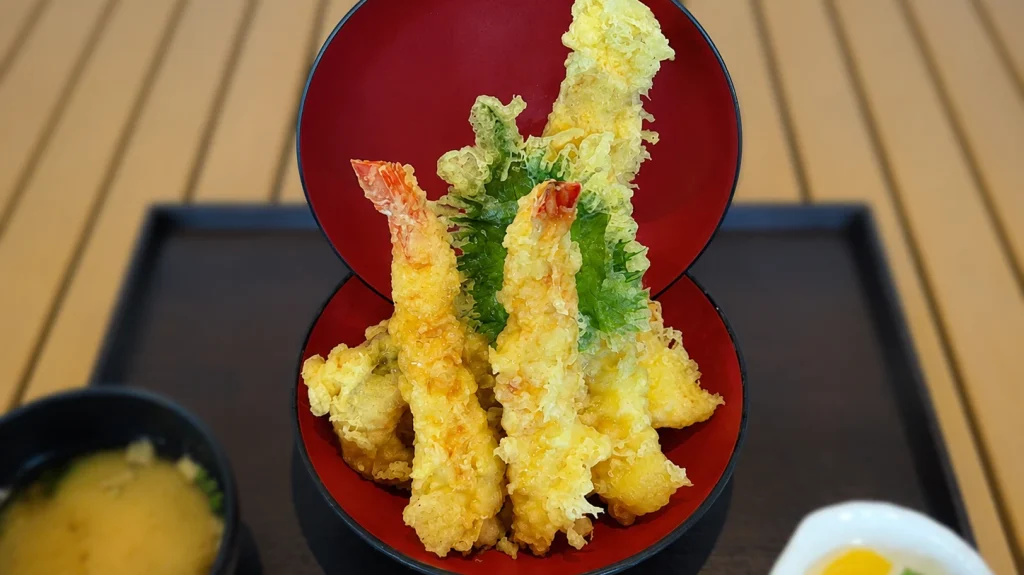
The Hama-no-Utase dining hall has two signature dishes. The Seasonal Kaisen-don (2,280 yen) and the Tachiuo-Ebi Tempura Bowl (Cutlassfish and Shrimp Tempura Rice Bowl, 2,280 yen) share the top billing.
The Seasonal Kaisen-don is built around the seasonal seafood landed that same day at Mishima Fishing Port right in front of the venue, changing daily (official site). The Tachiuo-Ebi Tempura Bowl pairs Mishima Fishing Port’s specialty tachiuo (cutlassfish; Japan’s top catch, Wakayama Prefecture / Arida City Official) with shrimp in tempura style — a way to enjoy Arida’s signature fish in tempura-bowl form.
Shirasu (whitebait) is also on offer from summer through autumn, alongside red sea bream, yellowtail, horse mackerel, and Spanish mackerel. Beyond the kaisen-don and the tempura bowl, the menu spans preparations by cooking method: sashimi set meals, Kishu shirasu rice bowls, and assorted tempura platters, among others.
Main Menu (as of May 2026)
| Item | Price (tax included) |
|---|---|
| Seasonal Kaisen-don | 2,280 yen |
| Cutlassfish & Shrimp Tempura Bowl | 2,280 yen |
| Hama-no-Uta Set | 2,280 yen |
| Sashimi Set Meal | 2,280 yen |
| Kishu Shirasu Rice Bowl | 1,580 yen |
| Sushi Lunch | 2,280 yen |
| All-Tuna Rice Bowl | 2,500 yen |
| Daily Fish Set Meal (weekdays only, limited quantity) | 1,380 yen |
| Topping Curry | from 700 yen |
| Mixed Fry Set | 1,580 yen |
| Assorted Tempura Platter | 1,780 yen |
| Honeku Tempura Udon / Soba | 780 yen |
The retail hall carries fresh fish, dried fish, and shirasu products sourced through the same route as the fish served in the dining hall.
The latest incoming catch and the daily fish list are posted on the official X (@hamanoutase), official Instagram (@hamanoutase), and official Facebook.
Note: Order-taking hours are 10:00–13:30 on weekdays and 10:00–14:30 on weekends and holidays. Since the seafood lineup changes daily, actual servings may differ from photos. Please confirm the day’s menu via the official SNS or in person at the shop. Each item ends when sold out.
3. Hama-no-Utase and Mishima Fishing Port
Mishima Fishing Port
The Miyazaki-cho / Mishima district of Arida City is one of Wakayama Prefecture’s principal fishing ports, facing the Kii Channel. Landings center on cutlassfish and shirasu fisheries.
May 2020: Hama-no-Utase Opens
Operated directly by the Mishima Fishery Cooperative, Hama-no-Utase opened as a market diner and retail shop in May 2020. The venue runs on a direct sales route — from fishing boat, to the cooperative, to the cooperative-run venue.
Since opening, it has been featured as a recommended spot by the Arida City Tourism Association (Arida City Tourism Association Official).
The site is equipped with free parking for more than 130 vehicles, traffic flow designed to accommodate large tour buses, and a combined retail-and-dining layout.
4. Visitor Voices
Voice 1: A Seafood Diner Right at the Fishing Port (@aridawakayama)
A post (April 2026) noting “the fishing port is right in front — the seafood diner Hama-no-Utase in Arida City, first visit in a while! Cutlassfish and shrimp tempura at 2,280 yen! Great volume!” The visitor also writes, “the retail section carries plenty of local Arida souvenirs alongside the fish — vegetables too, including mikan, plums, and shrimp crackers,” touching on the retail hall attached to the dining space.
Voice 2: An Overview of Kaisen-don, Tempura Bowls, and Set Meals (@a.takuya.1989)
A post (December 2025) noting “you can buy fresh, reasonably priced seafood, vegetables, and fruit, and at the dining hall you can have kaisen-don, tempura bowls, and set meals.” The visitor adds, “fresh, with a good amount of fat and pleasing texture — a fully satisfying lunch,” sharing impressions of the signature kaisen-don and the sashimi set meal.
Voice 3: Kaisen-don Variety and the Sea View (@cafegram_12)
A post (April 2026) noting “the kaisen-don had so many kinds of fish it was fantastic — the seaside seats had a beautiful view as well.” The visitor also writes, “a market was being held next door, and while waiting in line we could stroll around and enjoy it,” touching on how to spend the wait time.
Voice 4: High Praise for the Cutlassfish Tempura (@n.h6ak1)
A post (April 2026) noting “we had lunch at ‘Hama-no-Utase’ near Mishima Fishing Port in Kishu Arida — personally, the cutlassfish tempura was the best.” The visitor adds, “the weather was great too — the best,” recommending the local specialty cutlassfish.
Voice 5: Seasonal Kaisen-don and Cutlassfish Tempura Bowl (@rico_happy1)
A post (February 2026) noting “you can enjoy dishes made with fresh seafood landed at Mishima Fishing Port in Arida City, Wakayama Prefecture — famous for cutlassfish.” The visitor praises “an outstanding location,” “a fresh kaisen-don,” and “fluffy, generously portioned cutlassfish tempura,” adding, “at the adjoining direct-from-producer facility, you can pick up fresh seafood and produce,” conveying the combination of dining hall and direct-sales retail.
5. Getting There
By Public Transportation
- About 7 minutes by car from Minoshima Station on the JR Kisei Line (taxi recommended)
- From Osaka Station, the JR Limited Express Kuroshio reaches Minoshima Station in approximately 1 hour 30 minutes
Note: From Minoshima Station to Hama-no-Utase, a taxi or rental car is the practical option.
By Car
- About 30 minutes by car from the Kainan IC on the Hanwa Expressway
- About 25 minutes by car from the Arida-Minami IC on the Yuasa-Gobo Toll Road (a half IC with entry and exit only toward the Shirahama direction)
- About 1 hour 30 minutes from central Osaka
- About 50 minutes from central Wakayama City
Parking
Free parking for more than 130 vehicles, with tour-bus accommodation available (per the official site).
Map
6. Eight Sights Worth a Side Trip Nearby
Pair your visit to Hama-no-Utase with a stop at one of these tourist destinations in the Arida and Yuasa area. Below are eight picks listed roughly in order of proximity.
- Semui-ji Temple (Yuasa Town, about 12 minutes by car) — An old temple founded in 1231 by Yuasa Kagemoto (grandson of Yuasa Munesige), who invited the priest Myōe Shōnin as its founding abbot. The Yuasa Kagemoto donation deed prepared at the time of founding (a paper-and-ink deed of dedication) is a National Important Cultural Property, and four buildings — the main hall, founder’s hall, bell tower, and guardian shrine — are Wakayama Prefecture-designated Cultural Properties. Also known as a cherry-blossom viewing spot, the precincts command a view over Yuasa Bay. (Yuasa Town Tourism Association / Google Maps)
- Kōkoku-ji Temple (Yura Town, about 20 minutes by car) — Founded in 1227 by Kazurayama Kagetomo (Gansei, a retainer of Minamoto no Sanetomo) as the Shingon-sect temple “Saihō-ji.” In 1258, Hottō Kokushi (Kakushin) was invited as founding abbot, and Kakushin himself changed the temple to the Zen school; in 1340, Emperor Go-Murakami granted the present temple name “Kōkoku-ji.” Known as the birthplace in Japan of kinzanji-miso, soy sauce, and the shakuhachi flute (and its komusō mendicant tradition), it is an indispensable stop for travelers tracing the cultural origins of Yuasa soy sauce. (Wakayama Prefecture Official Tourism Site / Yura Town, Hidaka District Tourism Association / Google Maps)
- Kadochō Soy Sauce Brewery (Yuasa Town, about 15 minutes by car) — Founded in 1841 , the only brewery in Yuasa Town that continues to produce soy sauce in its historic structures today. Eleven of its structures — the main hall, brewing storehouse, soy sauce storehouse, kōji-muro (koji room), grain storehouse, and others — were collectively designated as “Kadochō (Kanō Family Residence)” Important Cultural Properties of Japan (2022). As a constituent property of the Japan Heritage “First Drop,” Kadochō embodies the birthplace of Yuasa soy sauce. (Official Site / Yuasa Town Tourism Association / Google Maps)
- Yuasa Preservation District for Groups of Traditional Buildings (Yuasa Town, about 15 minutes by car) — A nationally selected Important Preservation District for Groups of Traditional Buildings (2006), designated under the “brewing town” category and the only such district in Wakayama Prefecture (approx. 6.3 ha, about 400 m east-west by 280 m north-south). As the birthplace of Japanese soy sauce, it is also the stage of the Japan Heritage story “The First Drop: Kishū Yuasa, Birthplace of Soy Sauce Brewing” (certified 2017). Within the grid of “tōri” (main streets) and “shōji” (narrow lanes), Edo- to modern-era townhouses with white-plastered kura (storehouses), tsushi-nikai (low second floors), latticed doors, and “mushiko-mado” (insect-cage windows) stand densely together, including the long-established soy sauce brewery Kadochō (founded 1841) and the kinzanji-miso maker Ōta Kyūsuke Ginsei. The Kumano Kodō pilgrimage route cuts through the district, and strolling stops such as Daisenbori (the inner harbor once used for shipping soy sauce) and Jinburo (a museum converted from a former public bathhouse) let visitors breathe in the lingering aroma of brewing. (Official Site / Wakayama Prefecture Official Tourism Site / Yuasa Town Tourism Association / Google Maps)
- Inamura-no-Hi-no-Yakata (Tsunami Education Center) (Hirogawa Town, about 16 minutes by car) — A disaster-education facility commemorating Hamaguchi Goryō, who set fire to his own rice-straw stacks during the 1854 Earthquake and tsunami to light an evacuation path and guide villagers to safety. As the historical site behind the UN-designated World Tsunami Awareness Day (November 5), it received the “NIPPON Disaster-Prevention Heritage” excellence award in 2024. (Official Site / Wakayama Prefecture Official Tourism Site / Japan Heritage: Hyakusei no Ando / Google Maps)
- Zenpuku-in Shakadō (Kainan City, about 17 minutes by car) — A temple founded in 1214 by the Zen master Eisai, whose present Shakadō (Shakyamuni Hall) is said to have been built around 1327. It is a Zen-style Buddha hall — three bays wide by three bays deep, with a hipped roof and hongawara tile roofing — and, alongside the Buddha hall of Kōzan-ji in Yamaguchi Prefecture, it is designated a National Treasure as one of Japan’s oldest surviving Zen-style structures. Inside, the hall retains hiuchi-bari (fire-strike beams) characteristic of Zen-style architecture along the Seto Inland Sea, conveying the late Kamakura-period Zen idiom to the present day. (Kainan City Tourism Association / Google Maps)
- Yuasa Shōyu Marushin Honke (Yuasa Town, about 17 minutes by car) — A soy sauce brewery founded in 1881 , with bottlings honored at the Monde Selection Grand Gold Award (its Nama-ippon Kuromame entry has won every year since 2006). A constituent property of the Japan Heritage “First Drop.” (Official Site / Yuasa Town Tourism Association / Google Maps)
- Shirasaki Ocean Park (Yura Town, about 22 minutes by car) — A scenic coast where the contrast between capes of chalk-white limestone and deep indigo seas has earned it the nickname “the Aegean of Japan.” The limestone formed roughly 250 million years ago in the Permian period of the Paleozoic era, and fossils of fusulinids and crinoids can be spotted throughout the outcrops. The park lies within the Shirasaki Coast Prefectural Natural Park and is also one of Japan’s “100 Best Shorelines” (selected in 1996 by the Dai-Nippon Fisheries Society and others). On site, visitors will find observation decks, an auto-camping ground, and a Michi-no-Eki roadside station (serving shirasu-don and Shirasaki curry), while the photo spot where Hijiki-jima (Sea-Weed Island) nestles neatly inside the rock arch of Tategan-iwa is a popular draw. (Official Site / Wakayama Prefecture Official Tourism Site / Yura Town Tourism Association / Google Maps)
7. Other Kishu Seafood Routes Worth a Look
Hama-no-Utase is a market diner run directly by the fishery cooperative. Consider pairing it with these seafood-forward or local diners in the same Arida and Yuasa area.
- Kadoya Shokudo (Yuasa Town) — Founded in 1946, a one-minute walk from Yuasa Station. A long-established diner famed for its two-choice shirasu rice bowl — raw or kamaage (boiled)
- Steve Stone (America Village Cafeteria) (Mihama Town) — Known for the “Stevesu-don,” topped with salmon, shirasu, and salmon roe. A diner run by an NPO
- Cafe de Manma (Minabe Town) — A plum-farmer-run cafe with sea views. Not a seafood venue, but a fine base for enjoying Kishu’s coastal scenery and local ingredients
- Ryori-Yado Hashimoto-So (Hidaka Town) — A restaurant known for kue (longtooth grouper) cuisine. The place to go for serious seasonal Japanese fare — winter kue, summer pike conger, and more
8. Mishima Fishing Port and Kishu Seafood Culture
Mishima Fishing Port is one of the principal fishing ports in Arida City, Wakayama Prefecture. Facing the Kii Channel, it lands cutlassfish, shirasu, red sea bream, yellowtail, and more. Its cutlassfish landings are among the largest in Japan, and Arida cutlassfish is recognized as a Wakayama Prefecture branded fish (Wakayama Prefecture / Arida City Official).
Shirasu (whitebait) is landed in the transition zone between the Seto Inland Sea and the Kii Channel, and is distributed in kamaage-boiled, raw, and chirimen-dried forms. The Yuasa Town and Arida City coastline is known as a production area for Kishu shirasu.
Hama-no-Utase, as a fishery-cooperative-operated facility for these Kishu marine products, functions in a direct-delivery mode from the fishing port.
9. Pre-Visit Final Checklist
- ✅ Retail hours: 9:00–18:00
- ✅ Dining hours: 10:00–17:00 (meals 10:00–13:30; until 14:30 on weekends and holidays; drinks only thereafter)
- ✅ Closed: Wednesdays (open when a Wednesday falls on a national holiday); New Year holidays
- ✅ Payment: Cash only (credit cards, e-money, and QR code payment not accepted)
- ✅ Parking: Free, more than 130 spaces; tour-bus accommodation available
- ✅ Daily incoming catch: Confirm via official Instagram @hamanoutase / official Facebook
10. In Closing: The Fishery Cooperative’s Direct Diner at the Port
Hama-no-Utase is the market diner and retail shop operated directly by the Mishima Fishery Cooperative. Set within meters of the fishing boats, it serves seafood dishes and retail products routed straight from the port — anchored by its two signature dishes, the Seasonal Kaisen-don and the Tachiuo-Ebi Tempura Bowl (Cutlassfish and Shrimp Tempura Rice Bowl, each 2,280 yen). With free parking for more than 130 vehicles and traffic flow accommodating large tour buses, it works well as a leg of an Arida and Yuasa drive and as a seafood destination for Kansai-based day trips.
Last updated: July 5, 2026
Author: Wakayama Foodie Editorial Team
Published by: Wakayama Foodie